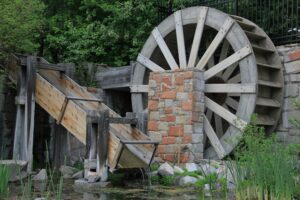
The Sim Corder/Harrison Mill offers a fascinating view of how earlier communities used smart design to turn natural power into productive work. Long before electric motors and computer-controlled equipment became common, mill builders relied on carefully arranged wheels, shafts, gears, belts, and structural supports. Every part had a purpose. Together, these systems helped workers process materials while saving time and physical effort.
What makes the mill especially interesting is the connection between its machinery and its building design. The structure did more than protect equipment from the weather. Its floors, beams, openings, and work areas supported the movement of power and materials. Studying the Sim Corder/Harrison Mill therefore reveals how practical engineering, skilled labor, and thoughtful architecture worked together in an earlier industrial age.
Turning Available Energy Into Useful Power
One of the greatest challenges for early mill builders was finding a dependable source of energy. Before widespread electricity, operators often relied on naturally available power. Flowing water offered a practical solution in suitable locations. A water-driven system could create steady movement that workers could transfer into machinery for demanding production tasks.
This process required careful control. The equipment had to capture enough energy to keep the mill running without putting too much pressure on its mechanical parts. Operators watched changing conditions and adjusted the system when necessary. The success of the mill depended on understanding both the machinery and the local environment. This balance between nature and engineering was one of the cleverest features of traditional mill technology.
Wheels and Shafts Moved Power Through the Mill
Generating energy was only the beginning. Mill builders also needed a way to carry that power from its source to machines located throughout the building. Rotating wheels and long shafts helped solve the problem. A main turning component could transfer motion through connected mechanical systems and keep several parts working together.
This design allowed the Sim Corder/Harrison Mill to make effective use of a limited power source. Instead of requiring separate energy systems for every machine, connected shafts could distribute movement where workers needed it. The arrangement demanded accurate construction. Poor alignment could create friction, reduce efficiency, or damage equipment. Builders therefore had to understand how each moving component affected the entire system.
Gears Provided Control and Mechanical Advantage
Gears were another important part of traditional mill machinery. Different gear sizes could change the speed or direction of movement. This gave workers greater control over how power reached individual machines. Large gears could interact with smaller ones to create the movement required for specific jobs without changing the source of energy.
The gear system also demonstrated how early engineers used simple mechanical ideas in highly practical ways. Properly shaped and positioned teeth had to fit together smoothly. Worn or damaged gears could interrupt production, so workers regularly inspected them. By combining gears with rotating shafts, mill builders created a flexible system that could perform complex work with technology that remained understandable and repairable.
Belts Helped Connect Different Machines
Many traditional industrial systems used belts to carry motion between rotating components. Belts could link shafts and machines without requiring every piece of equipment to sit directly beside the power source. This gave builders greater freedom when planning working areas and arranging machinery throughout a mill.
The belt system also helped make production easier to manage. Workers could sometimes engage or separate certain machines depending on the task. However, belts needed close attention because regular use caused stretching and wear. Proper tension was essential for safe and efficient operation. These practical concerns made routine inspection an important part of everyday mill work and required operators to understand how each connection behaved.
Building Design Followed the Needs of Machinery
The layout of a historic mill rarely happened by accident. Heavy machinery needed strong floors and reliable structural support. Shafts and belts needed room to move without hitting beams, walls, or other equipment. Materials also had to travel through the building efficiently. These needs influenced the shape and arrangement of the working space.
At the Sim Corder/Harrison Mill, design and machinery can be understood as parts of one larger system. Openings between floors may have supported the movement of mechanical parts or materials. Strong framing helped carry heavy loads and absorb vibration. Storage and production spaces also needed convenient connections. The building itself therefore became an essential part of the industrial process rather than a simple shell around machinery.
Skilled Workers Completed the Mechanical System
Even the most carefully designed machinery could not operate successfully without skilled workers. Mill operators had to watch equipment, control material flow, and respond quickly when conditions changed. They learned how machines sounded and moved during normal operation. An unusual noise or vibration could warn them that a part needed adjustment or repair.
Workers also needed to understand the limits of the equipment. Pushing machinery too hard could cause damage, while running it too slowly could reduce productivity. Experience helped operators find the right balance. Their knowledge became part of the mill’s working system. The machinery provided mechanical power, but human judgment kept that power useful, controlled, and dependable.
Repairs Required Creativity and Practical Knowledge
Modern businesses can often order replacement parts from specialized suppliers. Earlier mill operators did not always have that option. A broken component could stop production for a long period if workers could not repair it locally. For this reason, maintenance skills were just as important as operating skills.
Workers often repaired worn wooden or metal components, adjusted loose connections, and created replacement pieces when necessary. They used practical knowledge to keep the system running with available materials and tools. This repair culture reveals another clever feature of early mill design. Many machines were built in ways that skilled workers could understand, inspect, and maintain without depending on highly specialized outside services.
A Design That Supported Local Industry
The Sim Corder/Harrison Mill belonged to an era when communities relied heavily on nearby businesses. Farms and households needed local places where materials could be processed efficiently. A productive mill reduced the need for difficult travel and helped keep economic activity within the surrounding area. Its machinery therefore supported more than the work taking place inside the building.
The mill’s design helped connect natural resources, skilled workers, local producers, and customers. Mechanical systems increased the amount of work that people could complete in a day. At the same time, a practical building layout helped workers handle materials efficiently. These advantages made mills valuable parts of local economies and demonstrate how technical design could directly support community growth.
Preserving an Example of Early Engineering
Historic machinery helps modern visitors understand technology in ways that written descriptions cannot always provide. Seeing the size of gears, shafts, structural beams, and working spaces makes early engineering easier to imagine. Visitors can recognize how many individual parts had to cooperate before useful production could occur.
Preserving the Sim Corder/Harrison Mill protects this physical connection to earlier industrial knowledge. Its design shows that innovation did not begin with computers or modern factories. Earlier builders also searched for ways to use energy efficiently, organize work, and solve mechanical problems. The mill remains an important reminder that practical creativity and careful design have always played major roles in technological progress.